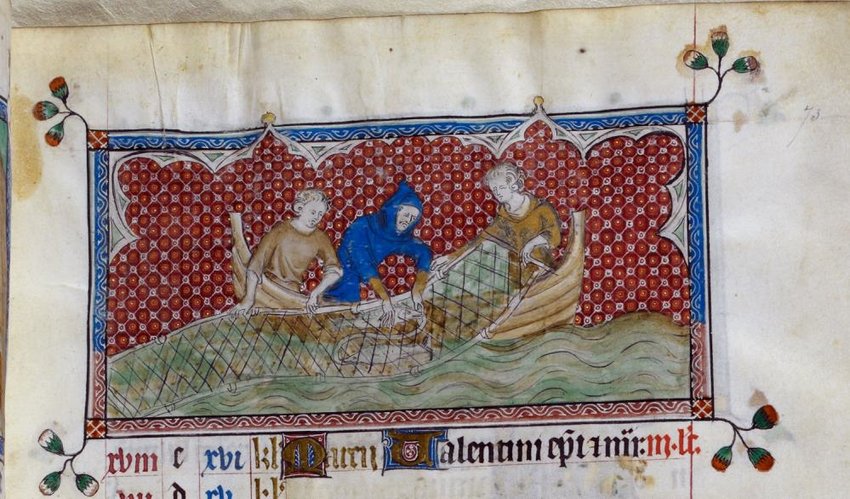
What was our place like before all of this?

Tibor Fischer’s short story ‘Crushed Mexican Spiders’ follows a young woman living in Brixton, London, who returns to her flat to find her key no longer works and that someone else is inside living her life. You never find out what is going on, but her sense of displacement is overwhelming, and sometimes it can feel like a lesser version of that when you consider the past – all those people who lived in your house or street or village once, who owned your world and would not recognise you.

Sometimes when I walk the dog on Barrow Common – a ridge that rises like a rampart behind the sand-filled harbours of North Norfolk – I imagine how terrifying it must have been for people essentially no different from us to look out over their familiar sea view one day at the end of the 8th century and watch the first wave of Viking longships approaching.

The Anglo-Saxons had themselves moved in and driven the local Celts westward following the retreat of Rome four centuries earlier – Branodunum and hundreds of other signs and structures of Roman occupation would still have been standing. Slowly the languages of these invading tribes coalesced into a single form that King Alfred was pleased to call English, and that we call Old English. The reason why we still have any of it now is because of scribes like the ones Alfred commissioned to create his library in Wessex, and thanks to whoever created the Exeter Book by inscribing the best of Old English poetry at the end of the 10th century.

Time doesn’t only separate. Unlike buildings and possessions which can be destroyed and stolen, the best phrases and stories are owned by none and stand the ravages of centuries longer than stone fortresses. They carry forward the soft essential experiences of living – preoccupations, loves and fears of the people who owned and shaped our language before us, walked where we walk, dug Norfolk soil, fished our coast and rivers, put up with British weather.

The Norfolk writer L.P. Hartley’s novel The Go-Between immortalised the peculiar divisiveness of time passing in his ironically immortal opening line: ‘The past is another country’.

I am looking forward to travelling there with Matthew Hollis and Bernard O’Donoghue on Sunday, and with Julia Blackburn on Saturday.
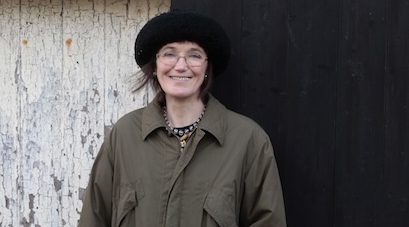
What is so unique about Katrina Porteous – winner (announced yesterday evening) of the prestigious Laurel Prize

She won!

The Laurel is the Poetry Society’s annual prize for environmental writing – poetry about nature and place, and we are thrilled that Katrina won – for her collection Rhizodont.

We love that Katrina…

• …embedded herself in a dwindling traditional fishing community near her grandparents’ house in Northumberland nearly 40 years ago. Katrina studied on a Harkness Fellowship in the USA, under Thom Gunn and Seamus Heaney – spending time in Native American Pueblo and Hopi communities in the South West, and in rural areas of the southern states. ‘An awareness’ – observes the Harkness blurb on Katrina – ‘of the universal importance of small-scale, sustainable local culture and ecology… has informed her work ever since’

• …turns complex scientific ideas into captivating poetry for non-scientists. Katrina’s collection Edge explored matter from quantum level – and the Large Hadron Collider – to the widest expanses of space

• …collaborates with artists and musicians such as Peter Zinovieff, Alistair Anderson and Julian May to produce performances about subjects from longshore drift to sea, sky and stars to the Uffington white horse to a journey beneath the ice of Antarctica. Read more about that lockdown project here

• …is President of the Northumbrian Language Society and the Coble and Keelboat Society and writes academic papers on the history of fishing and dialect research

• …named her latest book Rhizodont after the most recent ancestor we share with fish – a species that became extinct over 300 million years, found in the form of a 3-metre-long fossil off the Northumbrian coast. One reviewer said ‘Rhizodont does for the mining and fishing communities of post-Thatcher Northumberland what Heaney did for mid century Mid-Ulster, archiving the vast richness of its language, culture and work-lives. Porteous’ painterly eye for detail gives depth and resonance to the histories and dramas of her human and non-human subjects alike’ 

Or as Katrina explains herself: “For me, poetry is a kind of listening, and transmitting what I hear. I live on the coast, which constantly reminds me that human life is both vanishingly insignificant and astonishingly powerful. I want my poems to express that range of scale, to pass on what I’ve learnt from scientists and from my home communities – that small, local attachments can influence enormous planetary mechanisms, and that this brings hope. A multitude of voices, human and natural, imbue the poems in Rhizodont

Katrina will be reading from Rhizodont and talking to Patrick Galbraith on Sunday 5th October at Literature and Landscape. Please book here to join them

Schools’ poetry competition 2024

Our poetry competition is in full swing – open to all schools in North Norfolk. We want to hear what our local children have to say about the landscape and wildlife which surround them in this rural coastal strip.

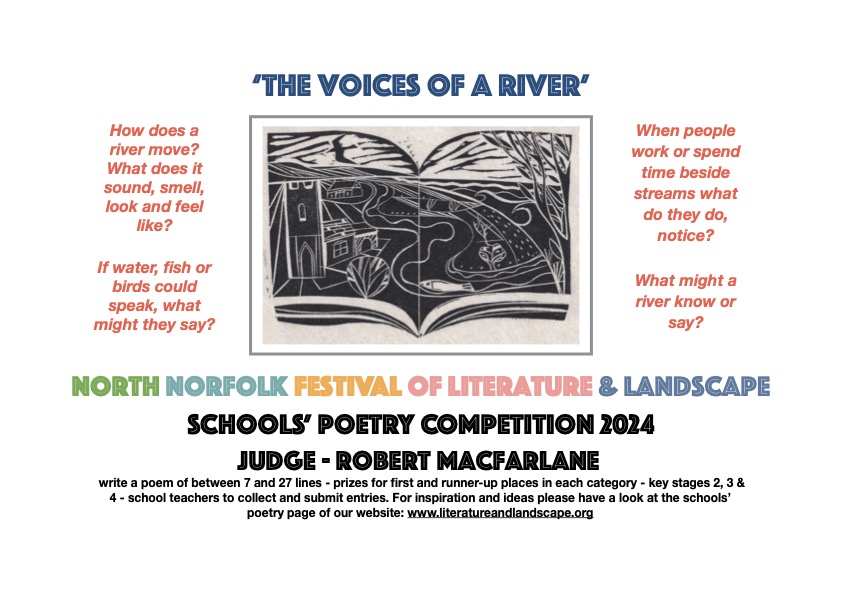
Here is our invitation:

The competition started when our festival was called Poetry-next-the-sea back in the 1990s and has run for a long time, kindly administrated by volunteers like Tim Fisher (who is running our nature workshops this year for schools and the general public). This year we are very excited to be able to announce that global superstar of nature writing and Cambridge professor of English, Robert Macfarlane will be judging the poems.

But there isn’t long to go. Entries must be in by the final minute of 27th September.

Our theme this year is ‘the voices of a river’ – inspired by Alice Oswald’s poetry and in particular her poem Dart – a poem in one whole book which follows a river in Devon from its source on the moors to its mouth, with the river speaking as it moves and changes through its course, using its own voice and the voices of people who live and work in or beside it.

You’ll find our rules here, photos, a summary and some inspiring river images here and a whole page of river poems here to read and think about.

We are all looking forward to reading your poetry.

Remember: 27th of September is the deadline!