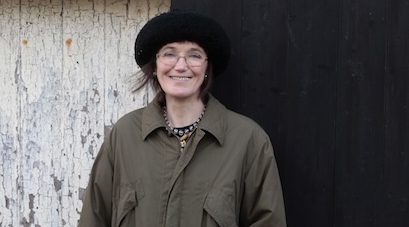
She won!
The Laurel is the Poetry Society’s annual prize for environmental writing – poetry about nature and place, and we are thrilled that Katrina won – for her collection Rhizodont.
We love that Katrina…
• …embedded herself in a dwindling traditional fishing community near her grandparents’ house in Northumberland nearly 40 years ago. Katrina studied on a Harkness Fellowship in the USA, under Thom Gunn and Seamus Heaney – spending time in Native American Pueblo and Hopi communities in the South West, and in rural areas of the southern states. ‘An awareness’ – observes the Harkness blurb on Katrina – ‘of the universal importance of small-scale, sustainable local culture and ecology… has informed her work ever since’
• …turns complex scientific ideas into captivating poetry for non-scientists. Katrina’s collection Edge explored matter from quantum level – and the Large Hadron Collider – to the widest expanses of space
• …collaborates with artists and musicians such as Peter Zinovieff, Alistair Anderson and Julian May to produce performances about subjects from longshore drift to sea, sky and stars to the Uffington white horse to a journey beneath the ice of Antarctica. Read more about that lockdown project here
• …is President of the Northumbrian Language Society and the Coble and Keelboat Society and writes academic papers on the history of fishing and dialect research
• …named her latest book Rhizodont after the most recent ancestor we share with fish – a species that became extinct over 300 million years, found in the form of a 3-metre-long fossil off the Northumbrian coast. One reviewer said ‘Rhizodont does for the mining and fishing communities of post-Thatcher Northumberland what Heaney did for mid century Mid-Ulster, archiving the vast richness of its language, culture and work-lives. Porteous’ painterly eye for detail gives depth and resonance to the histories and dramas of her human and non-human subjects alike’
Or as Katrina explains herself: “For me, poetry is a kind of listening, and transmitting what I hear. I live on the coast, which constantly reminds me that human life is both vanishingly insignificant and astonishingly powerful. I want my poems to express that range of scale, to pass on what I’ve learnt from scientists and from my home communities – that small, local attachments can influence enormous planetary mechanisms, and that this brings hope. A multitude of voices, human and natural, imbue the poems in Rhizodont“
Katrina will be reading from Rhizodont and talking to Patrick Galbraith on Sunday 5th October at Literature and Landscape. Please book here to join them

 Literature & Landscape